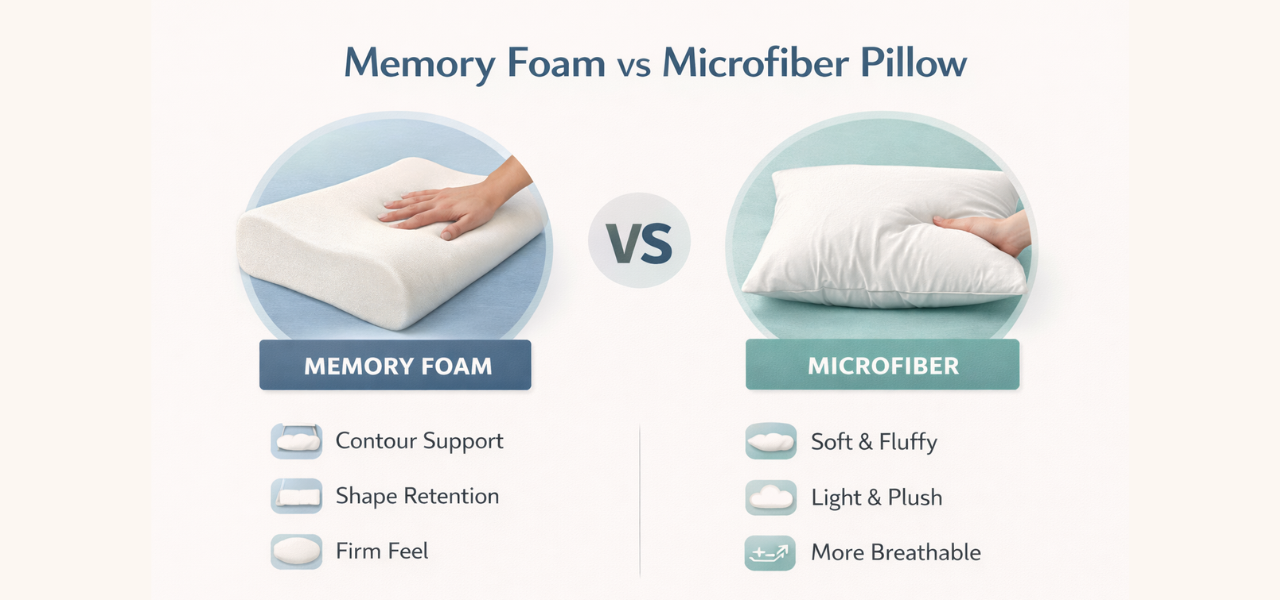
Memory Foam vs Microfiber Pillow. Have you ever woken up with a stiff neck and wondered if your pillow is the real problem? You’re not alone. Thousands of Indians struggle to choose between memory foam and microfiber pillows when shopping online. The big question everyone asks is – microfiber pillow is good or bad?”
If you’ve scrolled through Amazon or Flipkart, you’ve probably seen both these pillow types with similar ratings and wildly different prices. One costs ₹300, the other ₹1,500. Which one actually works?
In this guide, we’ll break down everything you need to know about microfiber and memory foam pillows – from materials to comfort, support, price, and suitability for Indian weather. By the end, you’ll know exactly which pillow deserves a spot on your bed.
What is a microfiber pillow made of? Let’s start with the basics.
A microfiber pillow is filled with ultra-fine synthetic fibers, usually polyester. These fibers are extremely thin – often finer than human hair. The microfiber pillow material is lightweight, soft, and fluffy, giving you that cloud-like feel when you rest your head.
Microfiber pillows are made by spinning polyester into very fine threads and then stuffing them into a pillow cover. Because the material is synthetic and mass-produced, these pillows are affordable and widely available across India.
Why are they so affordable?
Manufacturing microfiber is cheap, and the material is easy to wash and maintain. That’s why you can find a decent microfiber pillow for ₹300–₹800 on most e-commerce platforms.
Memory foam is a special type of viscoelastic foam that reacts to heat and pressure. When you lay your head on it, the foam softens and molds to the exact shape of your head and neck.
This contouring effect provides personalized support. Once you lift your head, the foam slowly returns to its original shape – hence the name \”memory\” foam.
Memory foam pillows are designed for pressure relief. They distribute weight evenly and reduce strain on the neck and shoulders. This makes them ideal for people with cervical pain, office workers, and side sleepers.
However, memory foam pillows are denser, heavier, and more expensive than microfiber pillows. In India, a good memory foam pillow can cost anywhere from ₹1,200 to ₹3,500.
Let’s compare both pillows side by side so you can see the differences clearly.
| Feature | Microfiber Pillow | Memory Foam Pillow |
| Support | Soft, less firm | Firm, contouring support |
| Comfort | Fluffy, cloud-like | Adaptive, molds to shape |
| Durability | Flattens in 6-12 months | Lasts 2-4 years |
| Price | ₹300 – ₹800 | ₹1,200 – ₹3,500 |
| Breathability | Good airflow | Can retain heat |
| Maintenance | Machine washable | Spot clean only |
| Best For | Budget buyers, guest rooms, kids | Neck pain, side sleepers, long-term use |
Let’s answer the most searched question: microfiber pillow is good or bad?
The truth? It depends on what you need. Here’s an honest breakdown of the pros and cons.
Bottom Line: A microfiber pillow is good for short-term comfort and budget purchases, but bad for long-term support and durability.
If you suffer from neck pain, memory foam pillow benefits are hard to beat.
Memory foam adapts to the natural curve of your neck, keeping your spine aligned while you sleep. This reduces pressure points and prevents waking up with stiffness or soreness.
Microfiber pillow benefits don’t extend to chronic neck pain. The soft, loose filling compresses under your head’s weight, causing your neck to bend unnaturally. Over time, this can worsen pain.
When microfiber works:
Microfiber may work for occasional mild discomfort or if you’re a back sleeper who doesn’t need much elevation. But if you experience regular pain, invest in memory foam.
Who should avoid microfiber:
If you’re searching for a pillow for neck pain, memory foam is the clear winner.
Indian summers are hot and humid. Choosing a pillow for Indian weather means prioritizing breathability.
Microfiber wins here. The loose, airy filling allows better airflow. It doesn’t trap heat like memory foam does.
Memory foam and heat retention:
Memory foam is denser, which means it retains body heat. In cities like Delhi, Mumbai, or Chennai during summer, this can make sleeping uncomfortable. Look for gel-infused memory foam pillows if you want the support without the heat.
Washing frequency:
In India, sweat and dust accumulate quickly. Microfiber pillows are machine washable, making them easier to maintain. Memory foam pillows can’t be washed – you can only spot clean the cover.
Verdict: For breathability and easy maintenance in Indian weather, microfiber is better. But if you need support and can tolerate slightly more warmth, choose gel-infused memory foam.
A microfiber pillow makes sense if you:
A memory foam pillow is the right choice if you:
So, which one should you choose? Here’s a simple decision-making formula:
Choose Microfiber If:
Choose Memory Foam If:
The Bottom Line:
When asking \”microfiber pillow is good or bad,\” remember it’s not black and white. A pillow material comparison shows that microfiber is good for budget-conscious buyers who value comfort and breathability. Memory foam is good for anyone prioritizing support, pain relief, and durability.
Both pillows have their place. Choose based on your needs, not just price.
1. What is microfiber pillow made of?
Ans: A microfiber pillow is made of ultra-fine polyester fibers that are thinner than human hair. The microfiber pillow material is synthetic, lightweight, and soft. Manufacturers spin polyester into very fine threads and stuff them into a pillow cover or cushion cover, creating a fluffy, cloud-like texture that feels smooth and comfortable while maintaining its shape.
2. Microfiber pillow is good or bad for neck pain?
Ans: Microfiber pillow is good or bad for neck pain depends on severity. For mild, occasional discomfort, a microfiber pillow may work. But for chronic neck pain, cervical issues, or tech neck, it’s bad because it doesn’t provide firm, structured support. Memory foam is better for consistent pain relief.
3. Does microfiber pillow flatten quickly?
Ans: Yes, most microfiber pillows flatten within 6–12 months of regular use. The loose polyester filling compresses over time and loses its original fluff. This is one of the main disadvantages compared to memory foam, which maintains its shape for 2–4 years.
4. Which pillow lasts longer – memory foam or microfiber?
Ans: Memory foam lasts much longer. A good quality memory foam pillow can last 2–4 years with proper care. Microfiber pillows typically need replacement every 6–12 months as they flatten and lose support. While memory foam costs more upfront, it offers better long-term value.
5. Is microfiber pillow good for summer in India?
Ans: Yes, microfiber pillows are better for Indian summers than memory foam. The loose filling allows better airflow and doesn’t trap heat like dense memory foam. Microfiber stays cooler in hot, humid weather, making it a more comfortable choice for summer months in cities like Mumbai, Delhi, or Chennai. Cushion


Contact Bazel for quick and reliable assistance with your home décor needs. Whether you have questions about cushion covers, orders, shipping, or returns, our team is here to help you every step of the way.
© 2026 bazel.in All rights reserved.


 Chat Now
